Dogs and cats sometimes swallow objects that cannot pass safely through the digestive tract. A toy, sock, bone, string, or other foreign material can become lodged in the esophagus, stomach, or intestines and cause a partial or complete obstruction.
Gastrointestinal obstruction is an emergency because trapped fluid and gas, loss of blood supply, tissue damage, perforation, infection, dehydration, and shock can develop. If you saw your pet swallow an object or suspect one is missing, contact a veterinarian promptly rather than waiting for severe symptoms.
Common Foreign Bodies in Dogs and Cats
Objects Commonly Swallowed by Dogs
- Socks, underwear, towels, and other fabric
- Toys, balls, and pieces of rubber or plastic
- Bones, corn cobs, fruit pits, and food packaging
- Rocks, mulch, sticks, and pieces of wood
- Pacifiers, bottle nipples, and children’s items
- Fishing hooks, needles, and other sharp objects
Objects Commonly Swallowed by Cats
- String, yarn, thread, ribbon, and dental floss
- Hair ties and rubber bands
- Needles attached to thread
- Small toys, foam, plastic, or fabric
- Tinsel and other decorations
An object does not have to be large to cause a problem. Small pets have narrower digestive tracts, and linear objects such as string can cause particularly serious intestinal injury.
Signs of a Foreign Body Obstruction
Symptoms vary with the object’s location, whether the blockage is partial or complete, and how long it has been present. Warning signs include:
- Vomiting or repeated retching
- Regurgitation, gagging, or repeated swallowing
- Excessive drooling
- Loss of appetite
- Lethargy, hiding, or weakness
- Abdominal pain, a tense abdomen, or reluctance to be handled
- Diarrhea, straining, or reduced stool
- Dehydration
- Weight loss when an obstruction is partial or develops over time
- Collapse or signs of shock in severe cases
A pet may still pass stool with a partial obstruction or because material already beyond the blockage is leaving the body. Normal or small bowel movements do not rule out an obstruction.
Where Can an Object Become Stuck?
Esophagus
An object lodged in the esophagus may cause sudden drooling, gagging, regurgitation, difficulty swallowing, repeated attempts to swallow, or distress after eating. A complete airway obstruction causes choking and is immediately life-threatening, but an esophageal foreign body can also cause severe tissue injury and aspiration.
Stomach
Some objects remain in the stomach and cause intermittent vomiting, appetite changes, or irritation. Others move into the small intestine and become lodged.
Small Intestine
An intestinal foreign body may create a partial or complete blockage. Obstruction near the stomach often causes more frequent vomiting, while a blockage farther down may produce more variable signs.
Why Are String and Other Linear Objects Dangerous?
A linear foreign body can become anchored under a cat’s tongue or in the stomach while the remainder travels into the intestines. Normal intestinal movement causes the bowel to gather along the object. The string can then cut into or through the intestinal wall.
If string, thread, ribbon, or another object is visible from the mouth or anus, do not pull it. Pulling can cause severe internal injury. Prevent chewing when possible and go to a veterinarian immediately.
When Is a Swallowed Object an Emergency?
Seek emergency care for:
- Difficulty breathing, choking, or blue or gray gums
- Repeated vomiting or inability to keep water down
- Severe abdominal pain or swelling
- Weakness, collapse, pale gums, or reduced responsiveness
- A swallowed sharp object, battery, magnet, fishing hook, needle, or long piece of string
- Vomiting with loss of appetite and lethargy
- Blood in vomit or stool
- A known object that is not passing as expected under veterinary monitoring
Do not wait for a known dangerous object to cause symptoms. Early evaluation may allow more treatment options and reduce the risk of tissue damage.
What Should I Do If My Pet Swallows Something?
- Prevent access to any remaining pieces.
- Identify the object and estimate its size, material, and time of ingestion.
- Check whether additional items are missing.
- Call a veterinarian or emergency hospital immediately.
- Bring a matching object, package, or photograph when available.
Do not induce vomiting unless a veterinarian specifically directs you to do so. Vomiting may cause additional injury when an object is sharp, large, corrosive, or likely to become lodged in the esophagus. Do not feed a bulky meal to “push” the object through and do not pull visible string.
How Veterinarians Diagnose a Foreign Body
The veterinarian will ask what may have been swallowed, when it happened, and which symptoms have developed. The examination may be followed by:
- Abdominal or chest X-rays
- Abdominal ultrasound
- Bloodwork to evaluate dehydration, electrolytes, infection, and organ function
- Contrast imaging or repeat X-rays in selected stable patients
- Endoscopy
- Exploratory surgery when obstruction or tissue injury is strongly suspected
Not every material appears clearly on a standard X-ray. Fabric, plastic, and other objects may be identified through their effects on the stomach or intestines rather than by seeing the object itself. Veterinary ultrasound can provide additional information about intestinal movement, distention, tissue, and abdominal fluid.
Can a Foreign Object Pass on Its Own?
Some small, smooth objects may pass, but this decision should be made with a veterinarian after considering the object’s size, shape, material, location, and the pet’s symptoms. A clinically stable pet may sometimes be monitored with repeat imaging to confirm that the object continues moving.
Home observation without veterinary assessment is risky. An object can stop moving, and symptoms can worsen as tissue becomes damaged. Persistent vomiting, pain, lethargy, loss of appetite, or failure of the object to progress may require immediate removal.
Endoscopic Retrieval
Endoscopy uses a flexible camera and specialized instruments passed through the mouth under anesthesia. It may allow removal of certain objects from the esophagus or stomach without opening the abdomen.
Endoscopy cannot safely reach every part of the small intestine and is not appropriate for every object, particularly when a linear foreign body, perforation, or advanced intestinal obstruction is suspected.
When Is Surgery Necessary?
Surgery may be needed when:
- The object is causing a complete or worsening obstruction
- The object cannot be reached safely with an endoscope
- A sharp or linear object threatens the intestinal wall
- Imaging suggests perforation, loss of blood supply, or abdominal infection
- The object is not moving during supervised monitoring
- The pet continues vomiting, becomes painful, or clinically deteriorates
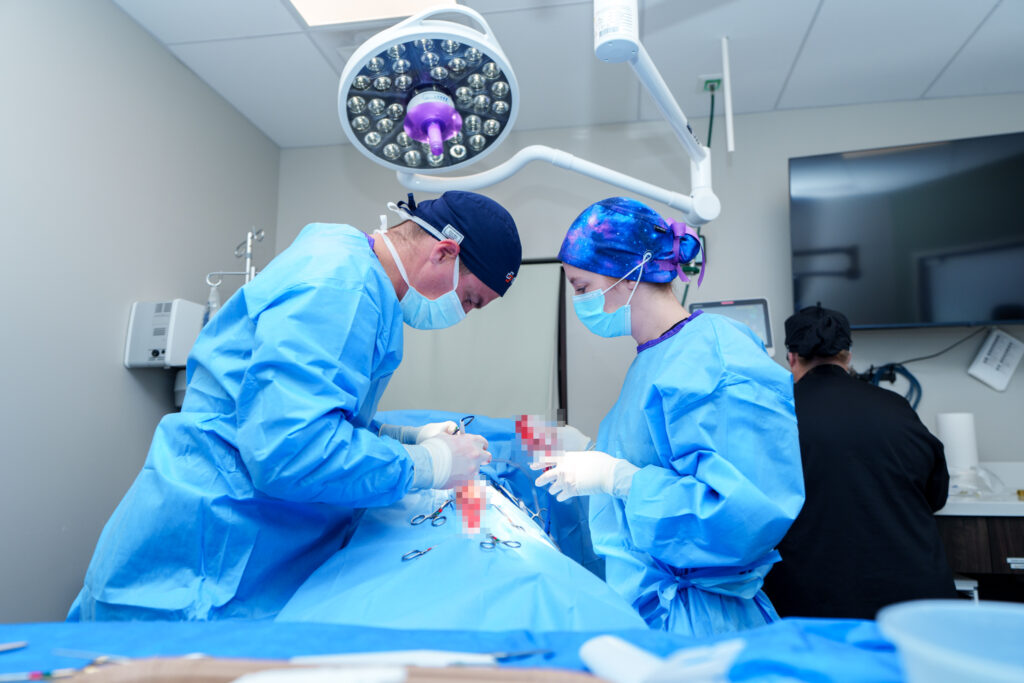
During surgery, the veterinarian removes the foreign material and evaluates the digestive tract. Damaged portions of intestine may need to be removed and the healthy ends reconnected. Fluid therapy, pain control, nausea medication, and careful postoperative monitoring support recovery.
How to Prevent Foreign Body Ingestion
- Choose toys that are too large to swallow and discard damaged pieces.
- Keep laundry, trash, children’s items, and food packaging secured.
- Store string, ribbon, sewing supplies, fishing gear, and hair ties in closed containers.
- Supervise pets with chews and toys.
- Discuss repeated non-food eating, or pica, with a veterinarian.
Emergency Care for a Possible Obstruction
Vomiting, appetite loss, abdominal pain, lethargy, or a known swallowed object warrants prompt veterinary guidance. Review the Top 10 pet emergencies, when a pet should see a veterinarian, and what to expect during an emergency vet visit.
COVE Pet Care provides emergency medicine and critical care and emergency surgery for dogs and cats with foreign body obstruction and other urgent conditions in Central Ohio.